


Exciton-polaritons are quasi-particles arising from the strong coupling between cavity photons and semiconductor excitons, exhibiting a half-light half-matter nature. The inherited photonic component enables polaritons with a low effective mass, which can overcome the bottleneck effect and achieve Bose-Einstein condensation at room temperature. The photonic component also allows their wavefunctions extend over macroscopic distances, resulting in long-range coherence and facilitates energy transfer and transport. This paves new ways for ultra-low-threshold polariton lasers and coherent photonic circuits. The excitonic component inherited by polaritons enables them with stronger nonlinear compared to conventional photonic systems, such as parametric scattering, showing significant application potential in ultrafast optical switches and all-optical circuits.

The temporal evolution of polaritons can be characterized by ultrafast spectroscopic techniques. A key dynamical feature of polaritons is their Rabi oscillations, which can be tracked on the femtosecond scale by femtosecond transient absorption (reflection) spectroscopy and two-dimensional electronic spectroscopy (2DES). In 2DES, excitation and detection frequencies are simultaneously resolved to generate two-dimensional spectra. By analyzing the frequency cross peaks in the two-dimensional maps, the Rabi oscillation of polaritons can be observed, thereby revealing the dynamics of polariton generation, energy exchange, and dephasing , which helps to gain a deeper understanding of polariton physics. On the picosecond and longer timescales, transient absorption (pump-probe) spectroscopy can be used to observe polariton relaxation dynamics, including the energy transfer between polaritons and the exciton reservoir, and elucidates the reservoir’s role in this process. The development of ultrafast spectroscopy techniques enables a more comprehensive understanding of the physical properties of polaritons and the realization of their manipulation.
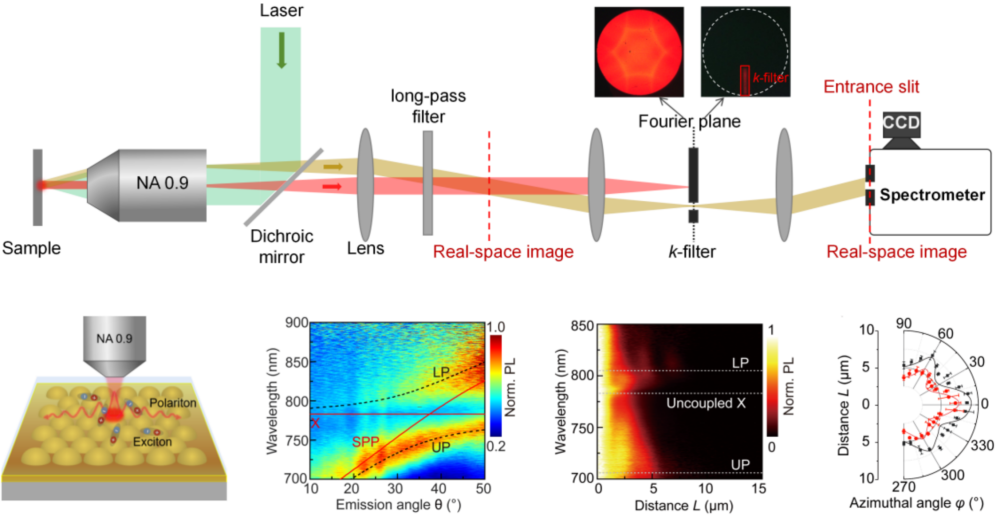
Exciton polaritons exhibit long-range coherence in real space, which is significant for energy transport engineering. Particularly in molecular systems, polaritons can overcome the localization of excitons to enable long distance energy transfer. As the photon fraction in polaritons increases, energy transport transition from diffusive to ballistic, with propagation velocity reaching two-thirds the speed of light. In engineered plasmonic arrays, polariton spatial transport displays high-contrast anisotropy, paving the way for anisotropic polariton devices. Improving the quality of the molecular exciton layer by chemical vapor deposition or replacing molecular layer with transition metal dichalcogenides to reduce disorder can increase energy transport distances. Improving the quality factor or lifetime of optical mode will further extend the range of energy propagation.
In momentum space, polariton formation is determined by the coupled system’s dispersion. The dispersion can be acquired via angle-resolved spectroscopy. Fitting the dispersion curve of polaritons can extract the coupling strength, Rabi energy photonic/excitonic fractions, and group velocities, thereby grasping their basic properties of polaritons. Parametric scattering is identified by observing stimulated scattering signals that satisfy energy and momentum conservation between the same or different dispersion curves. The occurrence of Bose-Einstein condensation can also be determined by observing whether polaritons accumulate in the lowest state of the lower polariton branch. Therefore, the dispersion of polaritons is extremely important for studying and revealing their unique physical properties.
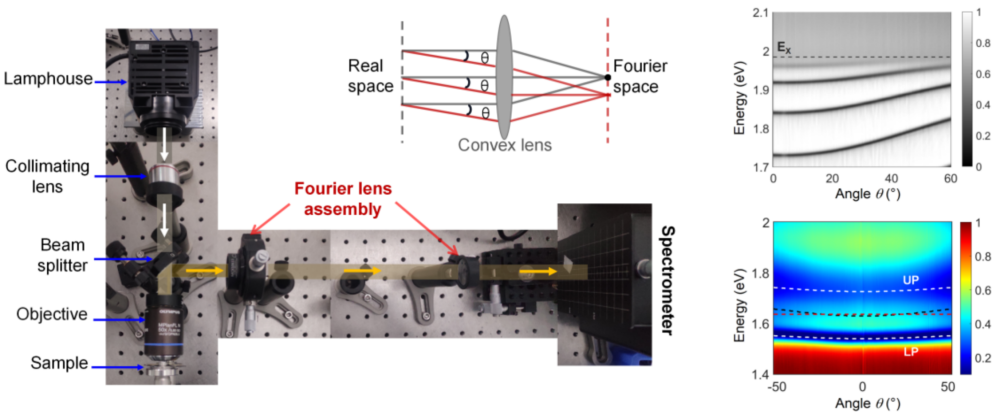
In our group, we try to combine ultrafast spectroscopy with real-space and momentum-space observations to gain a comprehensive understanding of polariton dynamics across temporal, spatial, and momentum scales. This comprehensive understanding will help us to better tune the properties of polaritons and promotes the development of novel, high-integration optoelectronic devices and quantum devices based on exciton-polaritons.